Saturday, 18 October 2014

114. Vignettes of Family Life in New Zealand: (9) Hot Pools in Waiwera, Snow in Happy Valley, Winter/Spring 1974


On the Devonport Ferry, Winter 1974
57, Sunnybrae Road, Takapuna, 14th June 1974*
    Dear Mum and Dad,
    Thank you for your letter of 28th May.
    Lewis' convulsions have not been connected with any special traumas or frights. He had two while we were in England but both were connected with sickness and were brought on by a sudden rise in temperature. The two here were not related to sickness in any way but were probably the result of getting over tired, he's a great rusher about. We've not had a TV since we came to New Zealand so it had nothing to do with horrors on children's hour!
    We are now entering our 'winter' which is marked by the period between two bank holidays, that for the Queen's Birthday, a fortnight ago, and Labour Day in October. Queen's Birthday was a beautiful clear day with very little wind and since it was a little cold for the sea we took the children to Waiwera, about 20 miles north of here, to the open air hot mineral pools. They had a marvellous time and we couldn't get them out of the water. It was warm enough to have a picnic lunch in the gardens that surround the pools - there are six pools of varying depths and temperatures, some for swimming in but mostly for just sitting in and relaxing - and very relaxing it is too.


    I have been very busy at the university this week. On Monday we started a new ten week lecture course on Industrial Democracy, on Tuesday I had to give a lunch-time talk to the Auckland Rotary Club and on Wednesday we were involved in running a management course for one of the local hotels.

27th June 1974
    Dear Mum and Dad,
    Many thanks for the marvellous birthday present. I have been meaning to read August 1914 for a long time but never got round to buying a copy - books are relatively expensive here. It's a massive tome and I hope to find time for it during our August break if not before. Pat has already got started on it so I won't get a look in for a while! Thank you too for the copy of Solzhenitsyn's address sent to the Nobel Prize committee.
    I had a very pleasant birthday. Pat and I went to the pictures the evening before to see The Sting which we enjoyed and on my birthday itself we all went to Waiwera (again) to enjoy the hot pools - that looks like becoming our favourite winter trip.
    Nothing much is happening here. We are all busy with work and school. Last night Pat and I went to see the teachers at Sunnybrae School to hear how Sacha and Stuart are getting along - pretty well on the whole. Stuart is very good at reading but careless with writing and spelling, particularly when he can't be bothered. He spends his lunchbreaks reading playlets with a group of friends (mostly girls) - seemed a good thing to us but the teacher obviously thought he should be roughing it around in the playground! Sacha, as you might imagine, is a real livewire at school. Recently her class went down to the Auckland docks and had a most interesting day there. Before she went Sacha thought a Wharfie (i.e. a docker) was some kind of monster!
    We have had some correspondence with Sheila Tan about jobs in New Zealand but unfortunately we are not able to help her much as we cannot cull much information about the employment prospects for Medical Secretaries. In general, however, jobs are plentiful and there are still no registered unemployed in Auckland.
    Lewis' pills seem to be stimulating him - he is the terror of the playcentre at the moment as he and a little friend, Richie, rush all over the place at a frantic pace - the supervisors will heave a sigh of relief when he goes to kindergarten which should be in a few weeks.
    Sorry for the delay in finishing this letter. Today (June 29th) it has been so warm that we have been sitting on Takapuna beach - in the middle of winter!
    Love from us all,
    Pat, John, Stuart, Sacha and Lewis.

Stuart in middle in blue jumper with his eyes shut.
Sacha sitting second from left.
27th July 1974
    Dear Mum and Dad,
    Thank you for your letter of 14th July with all your news - you certainly keep very busy.
    The Paddington Bear story has arrived safely and I'm sure Stuart will be very pleased. He identifies with Paddington because the bear is always messy and does silly things and eats a lot and makes people laugh - just like Stuart. He has quite a collection of the books now. I don't know what to suggest for presents. We seem to have so many things already and have the C.S. Lewis and A.A. Milne paperbacks. Last weekend we made a sort of puppet-theatre out of old bits of wood that the PlayCentre didn't want and Stuart in particular likes doing "theatricals" which may give you some idea for books. Books are still the best present really because they are that much more expensive here.
     Teachers do seem to be better paid here, although it is difficult to compare because the tax rates are higher here. I earn about £6000 before tax. Buying apples in 20lb lots at the Albany orchards costs about 5p a lb and a couple of weeks ago we bought 20lb of Chinese Gooseberries at c. 8p a lb.    Lewis has started at Kindergarten this week and likes it a lot. It is very well equipped and there is plenty for him to enjoy. The two staff seem very competent. One of them got married this week and Lewis came back saying that they had been throwing food at her. Pat asked him if it was rice? "Yes" he says and after a pause "and spaghetti"! But the spaghetti was really confetti.
    Today was Open Day at the University, so we went there this morning with the children. Stuart and Sacha found plenty to interest them. The engineering school had some working models going, the computer centre was also open and there were various film and drama activities to see. Yesterday evening we had a visitor from Nottingham University, a geologist, to dinner and the children made a great fuss of him.
    We have received confirmation from the YMCA that we can go to their chalet in the Tongariro National Park from Monday 26th August to Friday 30th August. We will be sharing with a number of other families since the chalet sleeps 32 people. It is near Mount Ruapehu just above The Chateau which was a big hotel I sent you some pictures of last year. The children are looking forward to seeing some snow and it will make a lovely break for us before the third university term starts in September. We have also been planning our summer holiday and hope to stay at Rotorua, then on Lake Taupo and then go to New Plymouth for a few days.

YMCA Chalet, Tongariro National Park, 27th August 1974
    It is spring in Auckland now and a couple of weeks ago we had a lovely sunny day on the beach at Long Bay. Then we went for a trip to Waiheke Island in the Hauraki Gulf, about ten miles by ferry from Auckland. We stayed a night with some friends near Onetangi and had some lovely walks. Now we are back in the middle of winter. Yesterday we drove down to this chalet just above The Chateau - it was a beautiful drive through rolling green countryside with hundreds (literally) of tiny new born lambs about. Last night there was quite a heavy fall of snow here and the children woke up to a real Christmas card scene with snow on all the trees and Mount Ruapehu, which is over 9000', at the back. This chalet is at the height of 3800'. This morning we had to fit chains on our car to drive up to 'The Top o' the Bruce' at 5300' where the skifields start. There are beginners slopes in Happy Valley and we all played there for a while, sliding down the snow on plastic sheeting rather than hiring skis and things. The children had had enough after about an hour by which time we were getting cold so we came back down again for lunch. This afternoon we drove down to Turangi to find somewhere to stay for our summer holiday and then came back to the chalet for tea. As well as the fantastic skifields here there are also many beautiful walks, and the views when the clouds lift, as they did this morning, are fantastic (again!).

Sliding down Happy Valley

    We are here as part of a group of 32 - twelve adults and 20 children. I think ours enjoy playing with all the others as much as anything. Lewis is the smallest so gets made a fuss of but since they all sleep communally - boys one end, girls the other - they keep each other awake at night and get everyone up first thing in the morning! Each family provides its own breakfast and lunch and then there is a menu for the evening where everyone brings the same food and it is all cooked together.

Wednesday
    To-day it is bright and sunny but with a very cold wind so we are going for a walk near The Chateau. Last night when all the children were in bed we played Scrabble, the first time for some years!

Mt Ngauruhoe (upper); by Lake Taupo with Ruapehu in the background (lower).

    Schools are on holiday now for two weeks and the university has a three week break. I don't know if I told you but I expect I shall join the Department of Management Studies in time for the 1975 academic year. We have already been planning the courses that I will teach, all of them third and fourth year courses in the Bachelor of Commerce degree. My principle teaching next year will be on Industrial Relations and Manpower Management. Because of my change of department my study leave arrangements are likely to remain a bit vague. Management Studies is a new department with only three staff at present and so some difficulty in covering staff leave. It is my intention to apply for leave in 1976 but next year is definitely not possible. I am sorry to disappoint Stuart if he was anticipating that I would be at his wedding. We also want to be able to afford to bring all the children too since it is unlikely at present that either you or Pat's parents will be coming to N.Z.
    Lots of love from us all, Pat John and children.

5th October 1974
    Dear Mum and Dad,
    It seems ages since we heard from you so hope you are both well and have settled  in at Church Road after the move. Last time we wrote was when we were at National Park and we posted the letter at the Top o' the Bruce on Mount Ruapehu so hope it arrived safely.
    The children are back at school now and Lewis is at kindy. They enjoyed their holiday at Ruapehu. We drove back round Lake Taupo on the most beautiful day as you will see when you get the slides. Auckland seemed quite smoggy after the lovely clean air in the mountains. We are hoping to go again next winter.
    The papers are full of gloomy stories about Britain's inflation and not very optimistic that the General Election coming up will solve anything. Hope its not that bad. Mr Kirk's death** was a great shock to people here, especially the Maoris who were very fond of hi. Love from us all,
    Pat, John, Stuart, Sacha + Lewis.

27th October
    We have been very busy here since we came back from our holiday at Tongariro National Park in August. We are now in the third and final term of the university year with about another month to go. It has been the busiest term for me with classes on four evenings of the week. This weekend, however, is Labour Weekend and tomorrow, Monday, is a bank holiday so we get a bit of a breather. Labour Weekend is generally taken as the sort of sign that summer is here - rather like May Day - so everyone is busy with their gardens or boats or whatever. Our latest addition is a tree hut in one of the tangled willow trees of our garden, constructed for Lewis primarily from odd bits of wood and from pieces of bamboo from the clump that grows along one side of our garden. The main use of the tree hut at present seems to be as a jailor for cops and robbers games with Stuart as jailer and Sacha and friends as internees.
    I was interested to hear that Stuart (brother) was doing some teaching at the Barbican. I spent quite a lot of time there when I was working for John Laing's on a project back in 1966 - they were one of the main contractors for the development.
    Thank you for the skipping rope you sent for Sacha's birthday and for the I-Spy books. Sacha had a pair of roller skates for her birthday and has been stumbling up and down our fairly long drive gradually getting the hang of it. Lewis and his friend Nicky take a skate each and sit a piece of board on them to ride down on. Plenty of spills.
    We have had a couple of outings since coming back from National Park. One splendid day climbing Rangitoto in the Hauraki Gulf. It is about 45 minutes by boat from Auckland and about a two mile climb to the summit from where you have marvellous views of the whole of the Gulf and the city of Auckland. We went with Alaister and Margaret Scott and Andy and Julie and also with the Smith family who were visiting here from the University of Southampton - Fred Smith used to be on the LSE staff and played cricket with Alaister and I in South London. We have also been to Wenderholm for a picnic, very peaceful with all the Kowhai trees in flower and yellow and green everywhere. And one rainy Saturday we all went to see The Three Musketeers at an Auckland cinema.
    Pat and I have also been out a bit. One evening we went to Rangi Walker's to a farewell party for Pare Mills who used to teach at the Centre (of Continuing Education) and was returning to Oxford. It was a very Maori occasion with lots of singing and speech making. Last week we welcomed another Maori to the staff of the Centre - Rev. Charlie Matai who is taking a leading part in the educational activities associated with a new Maori marae (or community centre), the Orakei marae in Auckland. In November I am going to another Auckland marae for a management seminar designed to discuss problems faced by Maori and other Polynesians in industry.
    Love to everyone from Pat, John, Stuart, Sacha and Lewis.
_____________________________________________________
*   For the origin of these letters see Love, Death and Letters from My Mother's Hut, blog 30, 4 February 2012.
** Norman Kirk was Prime Minister from 1972 to his death on 31st August 1974 following a heart attack; he was 51.
____________________________________________________________________________
Previous blogs in series
Vignettes of Family Life in New Zealand

    1.    72   Summer 1973-74 (incl. Queen at Waitangi), 13 November 2013. 
    2.    78   Summer 1979/80 (incl. Mt Erebus disaster), 27 November 2013.
    3.    80   Summer 1986/87 (incl. holiday, Pakatoa Island), 5 December 2013.
    4.    82   Christmas/New Year 1975/76 (incl. broken arm; dunking off Motutapu), 17 December 2013.
    5.    85   Christmas/New Year 1977/78 (incl. new ventures, Tutukaka, Whale Bay), 28 December 2013.
    6.    87   Christmas/New Year 1990/91 (incl. holiday, South Island), January 2014.
    7.    97   Winter 1987 (Rugby World Cup, Tikitere, Fairy Springs), 31 March 2014.
    8.  106   Summer 1982/83 ( Horse Riding in Ekatahuna: Milford Track Washout), 26 July 2014.

_________________________________________________________________________________

Friday, 10 October 2014

113. 'Don't think about building a wall. Think about laying one brick perfectly.'


In 2004 I enrolled in a workshop (two hours a week for eight weeks) on creative writing run by Judith White for the Auckland University Centre for Continuing Education.

There are many task-focused guidebooks on creative writing, complete with useful exercises for the novice writer. My interest, however, was in moving beyond theories and hints about ‘how to do it’ to focus on analysing ‘how it was done’. My purpose was to understand and illuminate, as explicitly as I was able, the process of creative writing as I experienced it over an eight week period.

Let me summarise what I discovered about the experience of creative writing in the course of my short apprenticeship. Here is part of what I wrote at that time.

Creative writing is by no means all creative experience. That 90:10 ratio of perspiration to inspiration seems to be the norm. But the 10% of inspiration is the drug that drives the whole caboodle, stimulating my desire to write and continue writing.

Creative writing is feast and famine. I have phases of obsessive activity in which everything else is crowded out by the work going on in my head. I live on the edge of my daily life, of the routines of eating and sleeping, of others’ conversations and concerns. At these times, I wake early – 3am or 4am – and scribble notes on pieces of paper and perhaps write for an hour or two. I begin to understand why creative folk have a reputation for being a nightmare to live with and am thankful for Sharon, a tolerant partner who sleeps well. I try to go with the flow, knowing these full moon risings won’t last, that the inspiration and energy will wane and be replaced by dead patches, calm resignation and aimless staring at Lake Pupuke. Eventually I know the wind will get up again and blow me in new directions.

There is a kind of creative ‘mucking about’ that seems to be part of the creative writing process. Doing nothing, going to movies and plays, watching television inertly, surfing the internet, moping about, walking round the rocks to Takapuna, watching the arctic terns assemble for their journey north, a scavenging seagull, a child exploring the waste basket, musing about the one-legged man with the three-legged dog, the long silences between Peter Hillary and his dad, broken by Ed saying “How would you like to go to the North Pole?” It all seems so random, yet is all grist to the mill. All potential material to channel into a story. One day. That mythical one day.

Stories have a life, style, rhythm of their own and take you to unexpected places. I’m never sure where I’m headed but am learning not to force the pace, to let a story, or a piece of dialogue, unravel in its own idiosyncratic manner. I’m not conscious of designing a style of writing that is integral to the story but, afterwards, can recognise a style is there, as with the carousel-like rhythm of the story-telling in Mr Oliphant’s Tears. [See blog 15, Mr Oliphant's Tears, 8 December 2011]

I love the intensity of the experience when writing, its immediacy and sense of total engagement. I feel as if I am permanently on the edge of a love affair, open and vulnerable to myself. ‘All the best art helps you understand some of your own questions’, says Naomi Watts, the star of 21 Grams*‘Like to write? of course, of course I do. I seem to live while I write – it is life, for me” - Elizabeth Barrett Browning.

I fill in the gaps in inspiration with the hard yards of revising and reworking and editing and find some useful writing habits to keep me persevering. I refuse to acknowledge writer’s block, learning that, if I have something to say, I will find words for it. Lousy words, perhaps, but words nevertheless. So I force them down… even if only jottings… dots on the screen… to be joined up later… with colour and frilly bits added… like stucco. I stop in the middle of a sentence so that I know where I am next time I visit the story. In the perspiration phase I take encouragement from these words from the actor Will Smith:
Don’t think about building a wall. Think about laying one brick perfectly. Just lay this one brick perfectly. Don’t let your mind wander to ‘Wow, when I’ve laid 14,000 of these bricks, it’s gonna be a great wall’. Just lay one perfect brick. In my mind I never look that far forward. I don’t hope that the movie is going to be incredible. I hope that this scene that we’re shooting today is going to be incredible. I try and make this scene the best that I can make it. And then in making this scene the best it can be, when they put them all together, hopefully they have something that is the best that it can be.**
I have a strange and disconcerting experience. I’m over in Bayview to see Harriet and James, her baby daughter, something I often do on Thursdays. On the way home I go into the Glenfield mall to look for a birthday present for Sharon. I wander around for a while, buy nothing, visit the toilet. Emerging from the cubicle in the gents I go to wash my hands. There is a long row of basins and mirrors. I wash my hands and look up to adjust my jacket. I am not there. No reflection. Just the basin in front of me, its mirror image and a view of cubicle doors beyond. I have disappeared.

There’s a simple explanation. In expecting what to see my mind has filled in some missing data. Sets of washbasins run back to back down the centre of the block facing the cubicles on each wall. Mine is the only set without a mirror so I’m looking straight through at the basin and cubicles on the other side. That I am not there is only a momentary perception but dislocating nevertheless. It sets me thinking about writers and mirrors, that the egotism of the writer needs the mirror of the publisher, not because writers have excessive narcissism but because they need to see their reflection to know that they exist. I remember that back in 1985, working at the East-West Centre in Hawaii and feeling much alone, I had visited the University of Hawaii library with the sole purpose of seeing whether or not they had a copy of a book I had written, a book about entrepreneurship and the founders and owners of small enterprises. They had. I did exist.

I also bring back from the mall two other perceptions about my developing psychology as a would-be fiction writer.

The first is the awareness that I can use the mirror experience in a story. I have no idea what story. Or when. But I am beginning to see, like some scavenging entrepreneur constantly on the lookout for new business opportunities, potential story pieces wherever I look. Everything is grist to the mill. When, as part of my 2002 photojournalism workshop, I go up to Karangahape Road with a camera borrowed from Wayne and walk into the old George Court building, it’s as though images are crying out at me to be shot. Within an hour I have used a thirty-six-exposure film – nothing by the standards of professional photographers, but a lot for a parsimonious Scotsman. And for weeks after the workshop I ‘see’ photographs wherever I go. If you are a hairdresser you notice people’s hair, if you work in a shoe shop, their shoes. Gradually my world is becoming a more dangerous place. What if that HSBC sign falls on my head, I wonder, or those kids’ bikes hanging precariously off the back of the four wheel drive on the motorway in front of me fall off in my path? My world is filling with ‘what ifs’.

My other recognition from the mirror in the mall is that dislocation is useful for a writer. A writer’s eye is for reversal of the expected, for the distorting image, as well as for the story or image that captures the essence of a particular person or place. I now recognise in my first tentative story lines the usefulness of inversion - the upside down clown hanging on my bedroom wall, the games I like to play switching between text and footnotes.*** Arthur Koestler writes that the creative act ‘does not create something out of nothing; it uncovers, selects, reshuffles, combines, synthesizes already existing facts, ideas, faculties, skills. The more familiar the parts, the more striking the new whole.’ Creative writing, to use Koestler’s terminology, is ‘bisociative’ not ‘associative’, by which he means that it doesn’t operate on a single plane with a given set of pedestrian rules but lives on several planes at once, rotating perception and cross-fertilizing to give new perspectives on the familiar.****


Text for My Photojournalism Display, Ilam 2002 (the blocked out word is re-presented/represented)


Some of My Workshop Photographs (printed the traditional darkroom way).
______________________________________________________

* In an interview reported in Canvas, 28/29 February 2004. Twenty-one grams is apparently the weight we all lose at the moment of our death thus provoking the speculation among the spiritually inclined that it is the weight of a person’s soul.

** From interview reported in Sunday Star-Times, June 2, 2002.

*** See blog, Thinking about Thinking (forthcoming).

**** Ideas here pinched from a study of ‘Suits’ and ‘Creatives’ in the advertising industry, an unpublished paper on the commercialisation of creativity by Lucy Thomas.

Sunday, 28 September 2014

112. Boarding at Wells Cathedral School 1949-1958: The Archaeology of a Box (17)


"The Cedars" and playing field (front left)
From the age of 9 until I left school at 18 I was a boarder at Wells Cathedral School in Somerset. In my box of treasures I have mementoes of those times - photos, letters, exam papers, school reports. In earlier blogs I also wrote about aspects of school life and so have added extracts (in italics) here. 

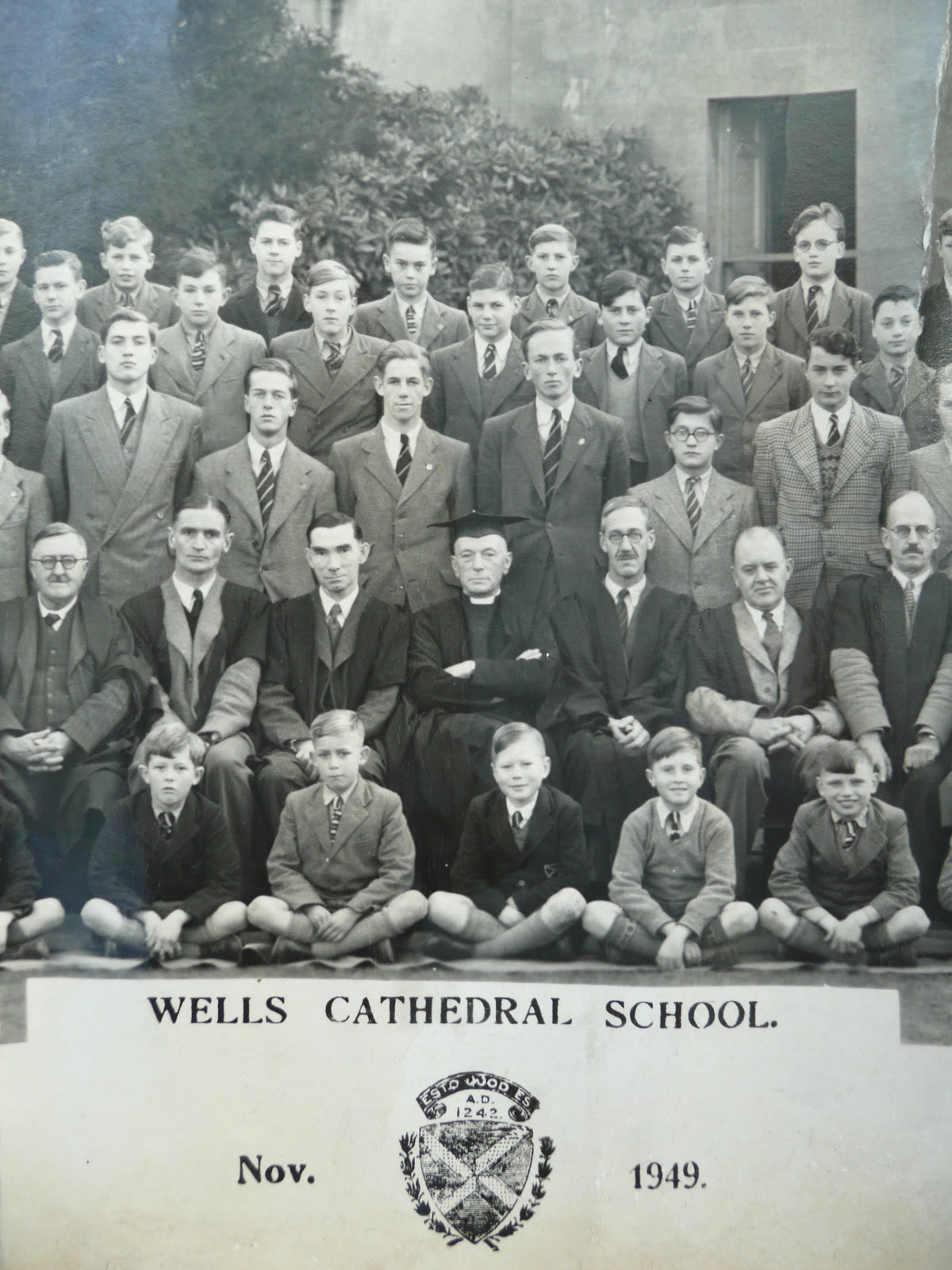
Rolled up in my box were three school photo scrolls, the first for 1949, the second for Coronation Year 1953, and the third for 1957.


That's me cross-legged in the middle of the 1949 School Photo


'Incicly Pedaary', Boarding School and a Demon of Arabian Mythology
[Extract from blog 48, 21 June 2012]

My father was ordained at Wells Cathedral in 1948 and became a curate at St Philip's Church, Odd Down, Bath. In the Michaelmas Term of 1949 I became a boarder at St. Andrew's, the Wells Cathedral Junior School. I was nine years old.

I was in the church choir at St Philip's so was entered for a choral scholarship to go to the cathedral school. There were sixteen applicants for one place apparently. I remember little of the process other than choosing to sing a hymn 'Hark the Herald Angels Sing'. I wasn't much of a singer, it was a hopelessly inappropriate piece to choose and I couldn't read music. I remember being very nervous and singing very loudly.

According to my mother's memoirs I was very disappointed not to be offered the scholarship. We had met Mr Hall, the Head of the Junior School, and had a look around and it seems I was keen to go there, so Mum and Dad scratched the money together to pay the fees.

Supervised writing home was a regular feature of weekend school life and my mother kept all the letters I wrote in that Michaelmas Term. The first of them is reproduced here.


Ruth is my younger sister who, in September 1949, would have been seven months old. Lynette was a family friend and Ruth's godmother.

Compared with most of my subsequent letters this was quite a long one. Gradually a quick run down on football or cricket matches and the latest cub activities were the dominant commentary on my boarding school life.

My friend Wilson - typically I don't remember his Christian name [later: I think it was Raymond] - also came from Bath but on the other side of the City from us. He lived in one of the Nissen Huts used to provide cheap housing after the war. He came to play with me at Odd Down during one of the school holidays and while he was there Marjorie, a very loud (in speech and dress) London cousin of my father, knocked on the door. Wilson opened it to be greeted with 'Allo ducks, ahm yer auntie.' I doubt that he ever forgot it.

In similar vein I recall that some years later I went in the school holidays for a spell to the home of Michael Skinner, one of my best friends at Wells. I was met off the train at Nuneaton by Michael, his Dad and his lovely big sister Barbara. His Dad's opening greeting left me momentarily non-plussed. As he shook my hand he said "Hello, when are you going home?" But I am sure I had a lovely holiday, the only part of which I can now remember is being taken to Trent Bridge to watch my first ever Test Match.

Here are some snippets from other letters sent home that first Michaelmas term. 


The School Headmaster at that time was Prebendary A.F. Ritchie (centre of photo below). It was only in my sixties that I discovered that as Afrit he was an important figure in the development of cryptic crosswords.

[To the left of Prebendary Ritchie are Mr Colchester, Mr Tarbat and Mr. Fisher *]
The extract below is from the article 'Afric's cryptic history' by Hugh Stephenson that appeared in the Guardian on 6th July 2009.
Those interested in the history of the cryptic crossword may like to know that Derek Harrison, who runs the admirable free crossword site http://www.crossword.org.uk/, has organised the reprinting of Prebendary AF Ritchie's Armchair Crosswords, first published 60 years ago and long since out of print. His daytime job was headmaster of Wells Cathedral School but he was more widely known as a setter of the fiendishly difficult weekly Listener puzzles under his nom de plume, Afrit - a powerful demon of Arabian mythology, which happened to be hidden in his initials and surname. Afrit was the first of three classics teachers centrally involved in the process of codifying the 'rules' of the modern cryptic crossword clue. (The other two were Derrick Macnutt, head of classics at Christ's Hospital in Sussex and Torquemada in the Observer, and Alec Robins, a Mancunian who taught classics at Chorlton Grammar School for boys and subsequently at Stand Grammar School for girls. He also set as Custos for the Guardian and for many other publications besides. Afrit's 1949 introduction to his collection of puzzles set out (in bold type) for the first time what became the golden rule of cryptic cluing: I need not mean what I say, but I must say what I mean. This key injunction to crossword setters was a play on the exchange in Alice in Wonderland where the March Hare says, 'Then you should say what you mean.' Alice replies, 'I do, at least - at least I mean what I say - that's the same thing, you know.'

Of Primary Schools, Pets and Pauper Lunatics
 [Extract from blog 33, 14 February 2012]

When I was a small boy we moved home multiple times. In this blog I piece together, with a variety of distractions along the way, an account of the places where I receive some primary school education. There are six in total, one a year on average before I go as a boarder to Wells Cathedral Junior School in September 1949. (Here is the school route in chronological order: 1. Monkton Combe, near Bath, Somerset; 2. Edinburgh; 3. Itchingfield, Sussex; 4. Cambridge; 5. Bath; 6. Wells.)
...
Finally in 1949 it is to school at Wells, initially travelling to and fro at the beginning and end of terms by bus from the Red Lion, Odd Down, Bath, later by train from Paddington in London, two routes locked in my memory. I could describe for you the landscape coming around particular corners on the bus route or the little halt (called Lavington I think) where we change trains for Wells but I won't bore you with further reminiscences along such branch lines. Is this fascination with and precise knowledge of how to get from place to place and recognition of all the stops along the way some psychological compensation for my sense of not knowing where on earth I belong, for frustration with all these child-time re-locations/dislocations? A product of an early life of moving around but never arriving at a settled destination? Of branch lines without termini? More of those night sea swimmings?

A final detour however. One of the last bus stops before Wells is outside the high walls of the Mendip Hospital, which back then was a mental institute or, as I and my schoolboy friends called it in those pre-PC days, the looneybin. As the bus comes down the hill you can see the extensive complex of the hospital below but this gradually disappears behind the high walls that surround it. I watch cautiously and curiously those who alight and embark at the stop beside the gate lodge. What I expect to see I have no idea; they are all probably cooks and cleaners and psychiatric nurses and not a looney among them. Until now, when I have googled Mendip Hospital, I have no idea of the history or scale of the place. It is one of many nineteenth century institutions set up with public funds to house and secure the mentally ill, usually in out of the way countryside places. The earliest is established in 1811.

The Mendip Hospital, built for four hundred patients and staff, opens on March 1st 1848 as the County Asylum for Pauper Lunatics. Its principal architect is George Gilbert Scott the designer of St Pancras Station and the Albert Memorial in London. It has a number of name changes over the years before being taken over by the National Health Service in 1948. In 1991 it is closed and the buildings converted into flats, apartments and homes which now form the core of the village of South Horrington.

If Miss Job, our Cambridge landlady has a strange relationship with her pets, it is nothing compared to that of our very own 'pauper lunatic' in Bath, Miss Hamper, who claims that her dog Billy has been given to her by the Emperor of Japan and can speak to her in Japanese, which unfortunately she doesn’t understand. Harmless as she seems to me, colourful indeed, even if a bit weird, they take her away and lock her up in the Mendip Hospital. She bequeaths us Billy, a pedigree cocker spaniel, and Mum renames him Blink, in memory of her own childhood spaniel. (What is it with the genteel middle class and their droopy sad-eyed spaniels?)  Much to my dismay, Blink subsequently displaces me in the family hierarchy since, in trying to recall my name in general conversation or to attract my attention, Mum often first goes through a brief recital of her other ‘children’ – Stuart! Elizabeth! Ruth! Blink! - a long pause… John! Ah well, Mum, I’m sure you loved me really, your firstborn son. But perhaps my ultra competitiveness was driven by a desire to rise above the status of a dog in the household pecking order.
...
And so to the Junior School at Wells to listen to David Fear, a weekly boarder, sobbing himself to sleep each night as he sucks on his big toe, a contortion we greatly envy. Within a year David is dead of a heart attack, falling down in front of us while we are rushing around in the play ground. We are really upset because he is the best half back we have in the school soccer team. I am happy that I failed to obtain a choral scholarship and so can play sport after school, rather than dress up in a choirboy suit and file off to the Cathedral for evensong. Not that all the switching of schools seems to have done me any great harm educationally. Indeed the Headmaster, Mr Hall, who sells me on the school when we go for the interview by talking to me about cricket and asking me to demonstrate my forward defence shot, comments in my first term’s report – in which I am top in everything – that I have been very well grounded in my previous schools, particularly in English, and by the end of my first year of ‘excellents’ and ‘very goods,’ and lots of stars and almost no stripes, and commendations for taking an interest and working really hard, he reports that I can play cricket quite well (only quite well, what a cheek) and that I must guard against the danger of too much success! What do they want, these teachers? I am even excellent at divinity.


By 1953 I had moved from St. Andrew's, the junior school, to The Cedars, one of the senior school houses. My housemaster was Alan Tarbat (seated far right below) who kept us in order with recourse occasionally to his cane called, rather unfortunately in retrospect, Little Willy.* 


[I am in the centre of the middle row of boys]

The Cedars was built in 1758 for Charles Tudway, MP for Wells. One evening in the main dayroom we discovered loose floorboards. We pulled enough of them up to create a gap under the floor into which the smallest of us - Crane I think - was able to crawl. He pulled out documents, papers and notebooks belonging to the Tudway family and we shared them around to keep. Mine were a collection of papers in a little leather wallet. There were recipes, estate accounts and information about the slaves on the family's sugar plantation in Antigua. I had that wallet for many years but mislaid it somehow. I was hoping one day to return it to the school as it clearly contained papers of historical interest. However, I don't think it matters much as I see there are 58 boxes of Tudway papers in the offices of the Somerset Archive and Record Service. These include Antiguan Estate Records from 1689 to 1893 and document the family's long association with slavery; 1821 papers list a total of 583 slaves working on the family's two Antiguan properties at that time. And there may well be more documents under The Cedars' floorboards.

In 1958 Alan Tarbat gave me a book, The Story of Wells Cathedral, as a leaving present. I found it among the papers in my box. It has some nice pieces about earlier days at the school.


Bishop Bekynton (1390-1465) was for a time secretary to Henry VI and Lord Privy Seal. He was consecrated Bishop of Bath and Wells in 1443 and has an unusual two-tier tomb in the Cathedral; on the upper he is represented in his full bishop's regalia and on the lower as a decaying corpse unwrapped from its shroud.


Mogg's Bakery and Jack Blandiver's Clock
[Extract from blog 5, 5 November 2011. Note: some names in this piece have been changed and the information about Watts' parents is invented.]

Proust had his Madeleine cakes. I had Mogg's.

From the age of nine I was a boarder at Wells Cathedral School in Somerset, an experience that among other good things gave me a love of choral music sung within large high spaces. Drifting on a sea of memory lapping around my nine years at Wells, up pops Mogg’s Bakery. Mogg was a dayboy at school whose family ran a bakery in the High Street that sold a tart-shaped cup cake, the cup a semi-soft biscuit soaked in honey, the filling a marzipan butter cream sealed under a hard smooth top of lemon, strawberry or chocolate icing. Lemon was my favourite.

I almost sold my soul for that cake, desperate as I was to inveigle an invitation to join my housemaster’s Sunday soirees at which I had heard, to my chagrin, cakes from Mogg’s were regularly served to his coterie of favourite boys, along with Bach, Corelli and Isaac Stern. I will call him Mr Crabtree. He taught maths, listened in rapt devotion to classical music and roused his favourites for morning chapel by tickling them. He was a server at the cathedral and, dressed in scarlet gown, starched white surplus and ruff, carried the cross at the front of the processing choir at evensong flanked by his candle-bearing acolytes, Michael Skinner and Michael Watts, similarly clad in the scarlet and white symbolic of the blood and body of Christ. In these proceedings, to my mind, Mr Crabtree and his angelic Michaels displayed an unctuous piety, my distaste fuelled by the knowledge of their imminent partaking of Mr Mogg’s cakes in the cosy warmth of Mr Crabtree’s rooms while I was left in the cold dayroom to play table tennis with my friends.

Sometime later Watts was expelled along with Hedges. Neither of them returned after the Lent half term. We were not told why and left to grubby speculation in the whisperings of changing rooms and the lewd graffiti of toilet walls. Two boys less likely to be linked we found it hard to imagine. Watts was musical, a chorister whose voice had broken, a gangly boy from Chislehurst in Kent who hated sport and was banished to right back in hockey teams to hide his hapless skills. His father had been killed in the Normandy landings and his elegant socialite mother picked him up on parents’ weekends in a much admired 1938 cream Lagonda Drophead Coupe with a running board and British Racing Green upholstery. Hedges was a weekly boarder from a farm in the Mendip Hills, a stocky Fordson tractor lad whose fearless tackling as our first fifteen fullback was greatly missed.

I have other reminiscences of schooldays and of boys who only have surnames, names on labels stitched to each piece of clothing by painstaking mothers. Steer, who objects to me calling him a native and smacks me in my smart-arse mouth when I explain he is a native of Bristol. Fear, who falls over in the playground during our lunchtime soccer game and dies. Crane who, as a ten year old, keeps a pin-up photograph of Heddy Lamar in his bedside locker until, distressed by my puritanical self-righteous goading that he must love Heddy Lamar more than his mother, he tears it up tearfully. Poor Hoskins unmercifully bullied and provoked to fight and lose in the depths of the boiler room; little wonder I thought Lord of the Flies was a documentary. Surnames and nicknames. ‘Stinker’ O’Halloran. ‘Kipper’ Herriman. ‘Brat Thompson’, ‘Squirt’ Stephens. Only in insults do we acquire an identity of our own.

I remember the rituals of school life. Taking my pullover, shirt, tie and vest off in one piece at night in order to enjoy extra minutes in bed in the morning before being chased into the showers and speed dressing for chapel. Cajoling the school barber on his monthly visits for a surreptitious look at his rubber Scotsman doll, which he squeezes between thumb and forefinger to make the kilt jump up and an erect pink penis pop out. Saving the cardboard milk bottle tops from my daily ration and flicking them competitively at the wall - nearest to the wall wins - to add to my cache. The endless round of clubs and sports and games to keep us out of mischief. Proud speech days and a shelf-full of books each with a school crest embossed on the cover and a citation on the inside – the first, T. H. White’s The Sword in the Stone, ‘Junior School Prize for General Work, Form III, 1950’, signed by the Head Master, A. F. Ritchie, Prebendary Alistair Ferguson Ritchie, headmaster from 1924, who I discovered later was, under the pseudonym AFRIT, a man of some considerable importance in the history and development of cryptic crosswords. Subsequent prize books were signed by AFRIT’s successor, F. G. Commings, who comes to Wells from St Paul’s School in London, the school attended by Samuel Pepys, and had been one of Orde Wingate’s Chindits in the war. 


I have kept two books about Wells. The older is The Story of Wells Cathedral by Richard Malden, ‘sometime Dean of Wells’. It has an inscription inside the front cover, ‘John S Deeks with all best wishes from A. C. Tarbat, Wells, July 23rd/’58’, a gift from my former housemaster to mark my leaving the school. The more recent is a historical guide to the town, published in 1990, a birthday present to me ‘With much love and many happy returns from Mum.’ Clearly I was expected to retain fond memories of my school days there, and do, by and large. I was a bright kid and good at sport, the ideal recipe for a happy boarding school life. It’s only looking back that I recognise how emotionally deprived I was and what a hopeless grounding an all boy’s boarding school is for coming to grips with the other half of the world, the feminine half. I suppose all the boys vied in our different ways for the attention of the younger and prettier of the matrons at the school, or of the headmaster’s teenage daughter or the eighteen year old bride of our housemaster, craving some mothering. From my nine years at the school I have only one recollection that touches that emotional hunger. A few of us were privileged, as sixth form students in English, to travel periodically with the headmaster and his wife to Stratford-on-Avon to see performances of Shakespeare plays there. Travelling back late at night I fell asleep in the back of the car cradled in the arms of the headmaster’s wife. It seemed a magical place to be. But that is it. Nine years and that is it. It appals me now to think of such emotional deprivation.


Among the papers in my box are a number of copies of The Wellensian. Among other things these termly magazines recorded the ups and downs of the school's sports activities.


Memory, a Long and Winding Lane
[Extract from blog 109, 22 August 2014]


Sports were compulsory at Wells and boarders played every day after school (apart from the choristers who went to the Cathedral for evensong). If pitches were unplayable because of rain we all had to go off on a run, something I hated even though I could happily run all day if there was a ball to chase. I played organised games of soccer and cricket in the junior school and, after moving up to the senior school in September 1951, rugby, cricket and hockey. At rugby I played fly half in the school under-14 team (aka stand off half, second five eighths, number 10) primarily because I had a good pair of hands and could kick with both feet. But I didn't like to tackle, was not a try scorer nor the team goalkicker. 

My eyesight deteriorated through my teens and I switched to hockey as my primary winter sport; I played right half. I continued to play rugby at fly half in house cup games, and I wheedled the sports master Mr Lewis to nominate me as linesman for the First XV so that I could go to away games and enjoy the after match teas. When I was in the sixth form I also played badminton and caddied for the Headmaster and Mr Carter, one of the Maths teachers, on some of their weekend golf games, invariably having a hit at the par 3 holes.

There were informal games of soccer and cricket as well, particularly after dinner on the long summer evenings. Sometimes this was a chance for extra practice in the cricket nets but often it would be a game of soccer, much to the disgust of the Headmaster when I sustained a minor injury that led to me being unavailable for a First XI cricket match. He also growled at me for playing with boys younger than myself saying it would undermine my authority as a prefect (not that I had much anyway!).
[The following Wells Cathedral School sports photographs are included in blog 109, Memory, a Long and Winding Lane, 22 August 2014: Junior School Sports Day 1950 or 1951; Under-14 Cricket XI 1953, signed by all the team members; 1st XI Hockey 1958; 1st XI Cricket 1958. I played cricket at Wells with Malcolm Nash who became a professional cricketer. An outline of his career with Glamorgan is included with particular reference to the game between Glamorgan and Nottinghamshire in 1968 that cemented his place in the history of first class cricket.]
Also among the papers in my box are those from my 'O', 'A' and 'S' level examinations. In 1955, when I had just turned 15, I took six subjects at 'Ordinary' level, including Latin. Throughout my schooling I was good at Maths. My father had been a Maths and Science teacher and he taught us a lot of mental arithmetic games when we were young. I liked the surface safety and rationality of maths, the world of theorems and proofs. I was very competitive and I liked the fact that you could get maths problems 100% right. In one school exam we were required to show all the calculations in the quadratic equations we had used to work out the angles in various geometric figures and conclude our answer with QED, quod erat demonstrandum. In one of my answers I, together with Arnold, my main maths rival in the class, neglected to write QED at the end. We were both deducted a mark so ended up with only 99% for the exam. I was deeply disgusted by such pedantry!

Also among my papers is a programme for the 1956 Cathedral Carol Service of 9th December 1956. I remember this traditional service of lessons and carols in a packed cathedral turned into a bit of a horror event for me. The third lesson was read by Michael Skinner, the fourth by me, the fifth by Frank Cummings and the sixth by the Dean of Wells. My lesson was St. Luke ii vv.1-7 in the King James Version: "And it came to pass in those days that there went out a decree from Caesar Augustus that all the world should be taxed" etc. Nothing very complicated but I had acquired a very nasty cold a few days earlier and my voice had almost gone. I asked the Headmaster to substitute me but he wasn't having that so I stumbled through it with great embarrassment. (It put me off public speaking for many years and I only regained my confidence in the late sixties when I took an excellent short course in London on "How to overcome nervous tension and speak well in public.")

Since Maths was my best 'O' level result, the teachers were keen that I should continue it to Advanced level, which was fine by me. But I really loved English too and was determined to continue with that. So in 1957 I took Pure and Applied Mathematics and History at Advanced ('A') level and English at Advanced and Scholarship ('S') level. The sixth form classes were very small and the three English teachers I had at that level - Mr Cummings, the Headmaster, Mr Jenkins and Mr Ramage were all brilliant in their very different ways. Mr Jenkins in particular largely ignored the set curriculum for the first year and introduced us to a wide range of literature, art and culture. In my scholarship exams I ended up writing about, among other things, Boethius' Consolation of Philosophy and obtained a distinction. (As one who subsequently spent many years marking university student exam papers, I know what a joy it is to find something different among the worthy but boring efforts of the majority of students.) I also remember how impressed I was that Jeremy Robertson, who was two years ahead of me, was researching and writing about The Epic of Gilgamesh.

In my final year at school I concentrated on taking entrance examinations for Oxford and Cambridge colleges, eventually being accepted at Selwyn College. These exams were under the supervision of the headmaster. Years later I saw the 2006 film of Alan Bennett's 2004 play The History Boys and recognised one of the examination tricks that Mr Cummings had taught me. This was to insert a memorable phrase into an answer. In a question about the role of the theatre critic I compared critics to the tasters at medieval banquets. In my interview for Selwyn College, James Winny, the Professor of English, suitably impressed by the analogy, asked me how I had come up with that idea. So I told him it wasn't mine, it was the headmaster's. I must have been accepted for my honesty rather than my originality!


The History and Mystery of My Bronchiectasis
[Extract from blog 21, 30 June 2011]

We moved home a number of times when I was a child. When I had my tonsils and adenoids removed we were living on the outskirts of Bath where my father, after completing theological studies at Ridley Hall Cambridge, took up his first position as curate of St Phillip's Church Odd Down. It was from there, at the age of nine, that I became a boarder at Wells Cathedral School. Home and school were healthy environments with plenty of fresh air and exercise and I was the kind of child who would happily spend hours at any game that involved kicking or hitting a ball. Photographs of me in those days show a boy of normal build for his age.

In 1952, when I was twelve, my father was appointed vicar of St John's Kilburn in London. In August we moved to Queen's Park, four underground stops from Marble Arch on the Bakerloo line so reasonably near the West End and centre of the city. I continued as a boarder at Wells until I left school at eighteen.

The year we arrived in London was the winter of A Proper Pea-Souper: the Terrible London Smog of 1952 (go to this link for excellent photos and details; at the end of it you will find an amusing little video clip of the British Government's 1947 advice as to how to deal with air pollution). The 1952 smog was a major environmental disaster in which an estimated 12,000 people died, primarily from pneumonia, bronchitis, tuberculosis and heart failure. While most of the deaths were among the elderly, unknown thousands were made ill with respiratory complaints and suffered long-term respiratory effects. These included inflammation of the lungs, permanent lung damage and, among children, increased susceptibility to infection.

Smogs (the word is an abbreviation for smoke and fog) were a feature of London life dating back centuries. The toxic darkness of the 1952 smog finally precipitated government action, eventually leading to the Clean Air Act of 1956. This Act put restrictions on the burning of coal in domestic stoves and fireplaces and encouraged the adoption of coke and other smokeless fuels for home heating.

I haven't researched the reasons for British Governments dragging their feet for so long in dealing with the air pollution in London. I would imagine, if the subsequent history of business resistance to the regulation of the tobacco industry is any guide, that the coal industry, prior to and during the general election of 1945, mounted a lobbyful of resistance to clean air legislation. The Labour Government elected in 1945 nationalised a number of industries, including the coal industry. With the setting up of the National Coal Board in 1946 the government itself became the key stakeholder in the coal industry but it was still ten years before clean air legislation was passed.

Smogs of variable intensity continued periodically in winter throughout my teenage years so I was exposed to them during my weeks at home for the Christmas holidays. One winter - I am not certain it was 1952 - I contracted a lung infection which led to a persistent cough and the stunting of my physical development. I stopped growing up and started growing round so that by the time I was eighteen I had a significant scoliosis and was well below the height appropriate for a healthy young man of my age. My nicknames at school became "shrimp" and "squirt" and I was the smallest in all the team photographs I have for that period. At home, when lounging around sprawled over couches and chairs as teenagers do, I was frequently admonished to sit up straight.

While I might be coughing my way through the Christmas holidays at Queen's Park, at school in Somerset I continued to be active and healthy. My developing scoliosis did not hamper me physically in any way and, to the best of my recall, never caused speculation or concern among the school staff. There was nothing in my school reports about my health and when my parents did enquire about my scoliosis it was dismissed, according to my mother's account, as a 'scholarly stoop.' I can only remember one episode of breathlessness when I came to a complete halt on a school run, an activity that was generally restricted to days when it was too wet to use the playing fields. After stopping for a minute or two I regained my breath and carried on running.

The extraordinary stunting of my physical development in my teens is clear from the last of the three school photos that I have, that for July 1957 when I had just turned 17.

[Mr Carter is seated third from the left*]

[That's me, the little guy in glasses just to the right of the Headmaster's wife; on my left is Michael Skinner and on my right working across to the left hand side, (Chris(?) Johnson, Robinson, Edward Greenway and Philip 'Kipper' Herriman.]
At the time of this photograph I was 5'5" tall and weighed 7 stone 9 pounds. A year later, when I left school I was 5 foot 8 and a half inches tall and weighed 8 stone 10 pounds. (The report below for the Michaelmas Term 1957 is clearly not mine.)


By the time I went on tour to Ireland in 1961 with the Selwyn College cricket team I was, according to my passport, 5'11". Here I am, second from the left in the back row, at the Guinness Brewery with my team mates.


____________________________________________

*Mr. Colchester, one of my later senior school housemasters (we called him Horse), used to stand on the upper landing outside his room and wake us all up in the morning with a loud bellow: "Hands off cocks, on socks"I still have some books of Mr. Colchester's, acquired when he was off-loading part of his library collection, including two books on the Danish Philosopher Soren Kierkegaard and a copy of Henri Bergson's Laughter (1900).

We were none too kind on some of our masters. I think we called Mr Tarbat "Podge" (but that could be pure fantasy on my part). Mr Carter, who taught Maths, could be goaded into hurling chalk and dustboards at us - I seem to remember he threw left handed. Most hapless of all was Mr Fisher who taught French and cried in front of us when George VI died. He had major problems with discipline and was undermined for all time when, getting in an apoplectic froth about something or other, his false teeth flew out onto the desk in front of him.

Thursday, 25 September 2014

111. Certification: The Archaeology of a Box (16)

Delving down towards the bottom of my box I find a collection of certificates rolled up inside a tube originally sent to me by the LSE after I concluded a postgraduate year there in 1963-64. I was never one for framing such things and sticking them on the walls of my various offices so they are still in pristine condition.


Three of these certificates are self-explanatory.


The fourth certificate, my Honourary Dagg Award, is perhaps the most precious of them all. It will mean little to anyone who is not a Kiwi and was presented to me in the 1970s by the students in one of my first evening class courses for Auckland University's Centre for Continuing Education.


Fred Dagg was a hugely popular character created in the 1970s by film and television satirist John Clarke. Dagging sheep involves cutting away the dags (matted wool and faeces) on the sheep's bottom.


Sunday, 7 September 2014

110. Mislaid Dreams, My Gap Year Souvenirs: The Archaeology of a Box (15)


This blog has been added to blog 61. Italy: From Castle Top to Hedgerow Bottom: My 1958-1960 Gap Years (5), 1 July 2013.