Sunday, 10 November 2013

70. The Blue Monkeys of Akrotiri

Detail from Blue Monkey Dance Party (2007)

The 2007 watercolour painting from which these monkeys are taken is titled Blue Monkey Dance Party and is one of two inspired by a visit in 1998 to the excavations at the prehistoric settlement of Akrotiri on the Mediterranean island of Thera (the classical name) - now better known officially as Thira or Santorini.
 
The ruins of Akrotiri that have been excavated include the Minoan city of c.1650 to 1500 BC though the site was continually inhabited from around 4500 BC. A massive volcanic eruption in the 17th century BC obliterated every trace of human activity on Thera for hundreds of years and created the astonishing volcanic cliff tops on which the Santorini towns of Fira and Oia now so dramatically sit.
 
The paintings found on the walls of Minoan houses excavated in Akrotiri are among the earliest examples of large-scale decorative art work in Europe. I was particularly taken with the lively energetic frescoes with blue monkeys in them.
 
Fresco of Blue Monkeys (Thera c.1500 BC)
There has been some speculation among historians of the ancient world as to the social and cultural significance of these monkeys. The monkeys were indigenous to Egypt and may have been taken to Thera as gifts or as pets. Alex III, in a Historum discussion forum, points out that some historians have placed these monkeys 'in a purely religious or cultural context, with the monkeys acting as a sort of mystical intermediary between the real world and the divine.' He traces the different strands of these arguments but concludes that, in his opinion 'art for the sake of art' is as good an explanation as any.

It was the art work that took my interest rather than any mystical baggage that might be associated with it. I particularly liked the idea of taking a drawing made by some unknown Minoan artist over three and a half thousand years ago and breathing new life into it. The Akrotiri fresco monkeys danced for me so I gave them a dance party to enjoy and then extended the idea by changing their colouring to red for a ragtime number.


For the original artist to imagine that his (or her?) frescoed monkeys might resurface millennia later in a part of the world he/she would never have known existed would be like me imagining that, in some future millennium, my paintings would be excavated by visitors from an inconceivable planet.


Friday, 25 October 2013

69. October 25th 1854: 'Into the Valley of Death...' NZ Connection to the Charge of the Light Brigade

'Stormed at with shot and shell, White horse and hero fell.'  [From 'The Charge of the Light Brigade' by Alfred, Lord Tennyson.]
They turned out at 4am and, as the sun rose, dissolving the mist in the valley ahead, James realised that the trap would be sprung that day. He retraced mentally the steps followed, the directions agreed upon, wanting to spot the mistakes, to know what might be, should be, learned from their collective madness. If not for himself and those with him – it was patently too late for that - then for others who might follow. For others would follow, that he knew. Perhaps for generations to come. Even if only for the sake of the historical record. They would want to pick over the entrails and know how he, of all people, had contributed to such a disaster, remembering him, not by his many victories but by this one cataclysmic defeat. Jealous rivals for preferment, journalists with bloodhound noses for bad news, political nobodies seeking electoral advantage, emotional voyeurs who, like uninvited funeral guests, took vicarious delight in the misfortunes and distress of others, all would give their verdicts. Reconstructing that day. Inventing stories. Grand stories of hubris and folly, and vignettes of cowardice and bravery in the face of death. Second-guessing motivation. Allocating blame. Wise after the event.

If it was to be defeat, James thought saddling up, then let it be one last glorious defeat that would be immortalised in history and poetry for generations to come. How would he be remembered, he wondered? Would only his mother mourn? Would he provide the lead his troop of dragoons expected? Disappointed that Joshua, his favourite charger, was lame and had to be left in the camp, and fearing his own cowardice, he reluctantly mounted Boadicea, his tetchy white mare, and led A troop to their allotted place at the right of the line. A mile away at the end of the valley the Cossack battery was waiting. When the order was given they advanced at a trot but within a few hundred yards came under fire and broke into a gallop.

His mother was never to know that it was that tetchy white mare Boadicea who made James a hero that day. Frightened by the shells bursting around her, she bolted. Straight at the Russian guns.


Captain J.A. Oldham was the first of the Light Brigade to get among the Russian guns at Balaclava on October 25th 1854. He was last seen wounded and bleeding in the smoke that hung in clouds over the battlefield, standing by a legless Boadicea, ‘his sword in one hand and his pistol in the other… His dead body was never found, and his grave is therefore unknown.’ After the battle a Russian officer came to the British camp under a flag of truce to arrange for the burial of the dead. “Who was the brave officer who rode a white horse and led the charge?” he asked.

The story of Captain Oldham’s horse is told in the 1911 regimental history of the 13th Hussars in these words: ‘This white mare was notoriously a brute, and on the occasion of the charge bolted – luckily, straight at the Russian guns.’ I particularly like the ‘luckily’! I invented the names of the horses but that is all. Captain Oldham’s brother was killed in New Zealand in an attack on a Maori pa. Wounded, he pressed on ‘in spite of all suggestions that his wound should be attended to; a few minutes later a second shot killed him.’ Who would be a mother?


Tuesday, 15 October 2013

67b. Memories (supplementary post).

See comments on blog 67 for origin of these photos and piece of text.

“5th January 1982. We’ve left Malvern on our way to High Wycombe and we’re going to Oxford. Just waiting on the weather forecast which I think’s real worth recording.

We’ve driven through Oxford and seen all the marvellous colleges and buildings of the university - it’s a huge place – some very old, some very new. I don’t know where we are now, we’re driving through a little town (yawn). People scurrying everywhere. The skies are about to burst open again with lots of flood and pestilence and snow. They are forecasting snow all over England again tonight.”


Wednesday 6th January
“Well, wrong wrong. It’s a beautiful day. It’s Wednesday the 6th of January and it’s taken quite a while for us to get organised to get out. Got two carloads and we’re off to High Wycombe and Maidenhead and then we’re going to Windsor, I believe Queen Elizabeth is expecting us for luncheon...

We’re now in the grounds of Windsor Castle looking at St. George’s Chapel. It’s a lovely fine day but it’s freezing in the air. It’s taken us about an hour to have lunch in a cosy little pub called The Mad Englishman. Took about ten minutes to get a cup of tea there but it was nice when we got it. Had my photograph taken a couple of times already with the bearskin people."


68. Me and My Dad

 
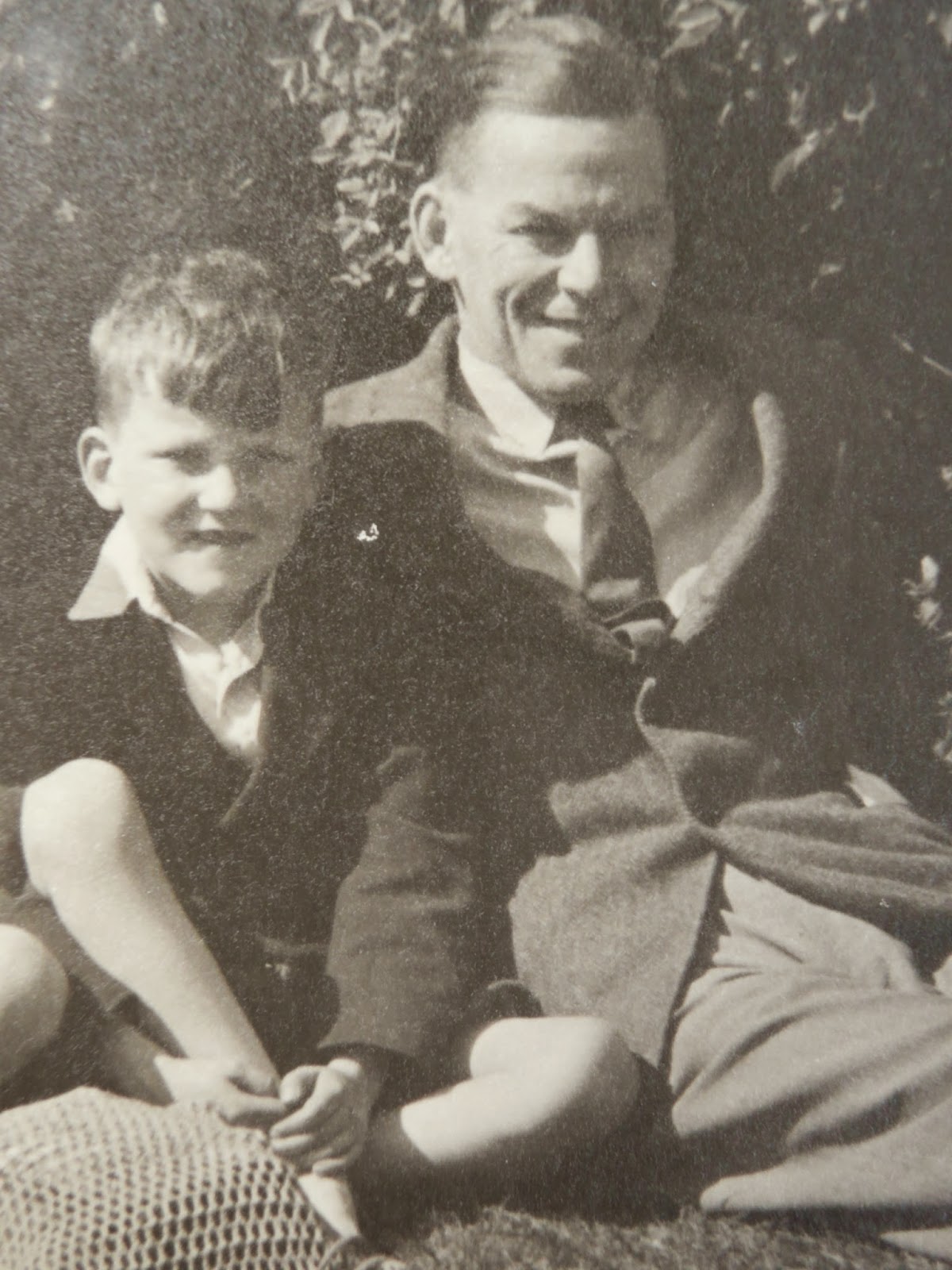
Me and My Dad c.1948
 
My Dad was a maths and science teacher who became a missionary school teacher in Nigeria and later the Southern Sudan. He was invalided out of Africa in 1943 with cerebral malaria and after the war was over went to theological college and trained for the priesthood. The rest of his working life was as an Anglican parish priest firstly in Bath, Somerset, then in Kilburn, London and finally in Malvern, Worcestershire.

To my way of thinking Dad was troubled by his need to keep his faith constantly in mind in the way he lived his daily life, incessantly worried about 'being right with God' and finding divine guidance for every little decision that had to be made. He seemed to me to find it difficult to lighten up and have some fun. In the words of modern business speak and spin doctoring, co-opting a religious vocabulary, he was always 'on mission', always on the lookout to helping others (a great quality) and to 'bearing witness', spreading the word of God (proselytising, which I personally found embarrassing and tiresome).

I read a piece by Diana Wichtel recently in the New Zealand Listener [September 14 2013] about Hugh Laurie the actor. 'Since his run as the irritable and unorthodox Dr House ended,' she writes, 'Hugh Laurie has moved on to play another man caught in a purgatory of his pain in the movie Mr.Pip...'  In his interview with Diana Wichtel, Hugh Laurie talks about his upbringing and the attitudes towards fun that it had imposed:
It comes from a very old sort of Presbyterian instinct that if something is enjoyable it can't be of any value. That pain is the only road to virtue or good work... I've tried very hard to shed that because I know that is mad.
Although my mother was the Presbyterian, my father was 'low church' and more sympathetic in temperament to some of the non-conformist practices of churches like the Methodists than to the elaborate rituals of 'high church' Anglicans. Our childhood Sundays, days without games, were dominated by communion, morning service, Sunday school and evening service. For a boy who just wanted to play cricket or kick a ball around in every spare moment it was hard to concentrate on bible study and being quiet for much of the day.

I found Dad to be very judgemental. How can you be otherwise if you are constantly having to find forgiveness for things - both in yourself and in others? You have to believe in sin to believe in forgiveness of sin. I did find Dad pretty inflexible in his judgements. It was Mum's contention that this mental inflexibility was a product of his cerebral malaria and that before that life threatening illness he had been much better at taking on board new ideas than he was subsequently. And yet he continued to be very alert in other ways, his mental arithmetic games when I was a kid being great fun - yes, he was fun at times back then. But arguing with him? I felt that really was a hopeless cause.

The paternal warmth and sensitivity my siblings found in my Dad was never particularly apparent to me. I think he felt awkward with me and I with him and I enjoyed the company of my Uncles Joe and Geoff a lot more, but that was easy because they weren't in my face about how I lived my life. Dad and I were essentially strangers, something I explored in my poem "The Tennis Racquet" (see blog 53) where the irony is, that in defining who one is in relation to a parent the simplistic alike/unlike binary means that the parent is still the point of reference for the characterisation of yourself. The parent has you either way. Fortunately the reality is far more complex and we are not just the mixed up sum of our parents' genes and predilections, however imprisoned we may feel by them on occasions. We can and do strike out on our own and create our own personae, build our character in interaction with the world as we experience it. However alike or unlike Dad or Mum I may be, it has not been a reference point for me - well, not for years anyway. Whichever traits and values of theirs I have taken on board are now comfortably embedded in who I am and I have learned to live with them and not to look for them to explain (or excuse) my own inadequacies and failings. Mum and Dad did their best, given the context of the times in which they lived, they loved me in their way and they allowed me to break free - you can do a lot worse in parents than that.

And I think, in trying to understand our parents' impact upon us, we underplay the context of their times - their social history and enculturation, their parental models, their expectations of different roles for men and women within the structure of family. Dad's life after all revolved around his work and the fact that his home was his office was something we all had to adjust to. And, OK, if he was distant from family matters much of the time (except when we went on holiday and had to all play at family), who is to say, in the greater scheme of things, that he was wrong to be so. Parishioner problems simply were more important, more immediate, more demanding than our childhood concerns. Dad was a great parish priest who helped people enormously and always went the extra mile for them. That was his vocation and I greatly admired his dedication to it even when I no longer shared the faith that drove it. It was Dad who comforted the mother and daughter on the Loch Fyne steamer when the husband and father had jumped overboard in front of them to drown himself (successfully) and Dad who kept in touch with them afterwards. It was Dad who visited Freddy Mayes over all Freddy's years in different prisons around the country, just as Elizabeth subsequently did up until Freddy's prison death earlier this year. You don't have to accept the beliefs to value the behaviours they generate.  

______________________________________________________________
For more on my Dad see these blogs:
  •   8.  A Place to Stand, a Place to Sit [17 November 2011]
  • 16.  Mum and Dad's Golden Wedding [15 December 2011]
  • 19.  In London, In Love [27 December 2011]
  • 21.  "Why Me?" The History and Mystery of My Bronchiectasis [30 December 2011]
  • 24.  Jesus v Lenin; the Unlicensed Tongue of a Teenage Boy [13 January 2012]
  • 53.  Adrift on Poetry [24 September 2012]; poem: "The Tennis Racquet".
___________________________________________________________________________


Saturday, 12 October 2013

67. Memories


“After Harrods we went to Evita which was really good, we’ve been playing the record for ages. Not as colourful as I expected but that was quite a thrill to see the show. We had a lovely dinner at Le Bistro, a little French restaurant in Drury Lane, where the theatre was."

This excerpt from Mary's tape of our 1981-82 trip to Los Angeles and Europe reminds me of how few memories I have of the trip other than those that are on film or tape. Even some of those are a surprise to me – I had forgotten that we went to see Evita, just as I had forgotten that in Los Angeles we saw Elizabeth Taylor on stage in Little Foxes. Indeed I am racking my brain to see what I can remember other than what’s on record, and it’s very little. I remember Mary throwing up at the bottom of the Vicar’s Close in Wells and again outside the terminal at Charles de Gaulle when we are waiting for a taxi to take us into Paris. And I remember our visit to the L’Oreal head office, just before we visited the Paris Opera. It had been organised by a friend of Mary's, L’Oreal’s New Zealand managing director, and was the remnant of the month she originally arranged to work there as part of her leave from the tech. But we  were given the kind of frosty supercilious bum’s rush reception that some Parisians had so effortlessly turned into an art form for country cousins, and were in and out of the offices within twenty minutes – not even a cup of coffee. Mary was disappointed and I, knowing how much she had been looking forward to it, was disgusted but said nothing.

Beyond that I can remember little, no matter how hard I try. In fact the harder I try, the less it seems I can remember. Nor do the tapes and photographs prompt additional memories of our visit, though they do trigger amazing recall of other times spent in some of the places – happy memories of Covent Garden, for example, buying gifts to bring home, enjoying the buskers with Sharon, and of working at Harrods in my teens, right down to the name of the buyer in the fruit and vege department my second Christmas there (Mr. Croft) – but nothing about other things that Mary and I did that winter. It’s as though, beyond the recorded stories, there’s just a void.

No wonder archaeologists and historians have such difficulty reconstructing the past. There are so many stories that could be told just from the source materials that exist, source materials that are mere fragments of a larger whole. We take snapshots of the celebratory events in our lives for the public family record – Pat and my wedding, Ruth and Trevor's wedding, Stuart and Jutka's wedding, Robert as a newborn baby, Nicola on her third birthday, Mum and Dad’s Golden Wedding celebrations, Sharon and my honeymoon in Tahiti, our Mediterranean cruise, our holidays in all their variety – and we retell those narratives of the photograph album, happy narratives by and large, narratives of the good times. But we don’t generally take photographs at funerals. We didn’t line everyone up with a professional photographer for a picture of Grannie Deeks' funeral party, even though it was the largest family gathering for years and none of the giggling grandchildren would ever forget Aunty Molly, in her funereal black, slipping and falling into the grave as she threw in her piece of soil.

The trauma narratives, the narratives of the bad times, of accidents, illnesses and deaths, are stored off-record, repressed and hidden, to be dug up by counsellors and psychotherapists and rebirthers for clues to our inner selves. When Sacha was kicked by a horse, I only took a photograph of her smashed-up nose after the cosmetic surgeon had completed his beautiful reconstruction and you could only see two black eyes and a large piece of sticking plaster rather than the gooey mess that I had welcomed from the ambulance at Middlemore Hospital. Such events are generally ignored by the photographic record, which is why I was momentarily shocked when Mum sent me a photograph of an earless Dad, a photo that she, with the fascination of a wartime nurse for surgical procedures, had taken after his cancerous growth was removed and before his prosthetic ear was fitted. They were also glossed over in my letters to Mum and Dad, letters that told of the trivia of my everyday life, the ordinary repetitive routines, the narrative of the normal.

But we don’t necessarily construct our stories of ourselves, our lives, from the normal. We are more likely to try and make sense of ourselves from the special occasions, public or private, celebratory or traumatic, that are permanently imprinted in our consciousness. From the embroidered tale of boyhood heroism as I jump ashore to rescue the family lest they capsize and drown in the River Arun. From private personal events in which we disclose ourselves to ourselves - the care and tenderness I share with Mary after she comes home from her radium treatment full of tales from other patients about the loss of their love lives, the loss of the sensations of passion and arousal. And somewhere in between these public and private lives is the normality of who we are in our everyday selves.

Evita, Harrods.... what strange connections. Are all memories like some vast underground network in which, if you know the interchange points, you can travel to and fro through your personal universe, making connections between everything? Like some holistic Gaia world nestling in a simple geometry of circles and lines, a world where past, present and future share a single time zone?

Monday, 23 September 2013

66. Former clergyman hanged ' in the Pett... in a Transport of Rage and Fury..'

On Tuesday the 31st of March 1691, following the Assizes at York, Mr. Edmund Robinson, condemned for high treason the previous week, was executed. A married man with a son, he was one of eleven convicted criminals hung that day. Two were executed for murder, two for burglary, three for horse-stealing and one for burning down a barn.

Edmund Robinson, born in Colne Parish in the County of Lancaster, Nicholas Battersby of the City of York, and Robert Cokeson from the Parish of Wakefield in the County of York, were executed for the high treason of counterfeiting the King’s coin. All three denied their guilt.

The day before their execution the Reverend George Halley MA preached a sermon at York Castle before the condemned prisoners. The sermon was published in London later the same year together with an appendix giving Halley’s account of the life and trial of Edmund Robinson, himself a former clergyman. After schooling and some university studies, Robinson had been ordained both Deacon and Priest and spent about eleven years in a curacy at Holmforth, part of the Parish of Kirk-Burton in Yorkshire. He also preached for a year at Haworth in the Parish of Bradford, a place later to become the home of the Bronte family. Edmund Robinson, however, was not an exemplary curate. He forged licences, conducted clandestine marriage celebrations and, according to Halley, was actively ‘impairing and Counterfeiting the King’s Coyn’ when living in the Parish of Kirk-Burton.

At school it seems Robinson had struck up a friendship with a young man called Greggson whose father had a reputation as a ‘Coyner’ and who was himself later executed at Lancaster for coining. Whatever the origins of his criminal predilections, Robinson was able to explain to Halley all the tricks of his ‘Black Art’, ‘what difference there was, as to advantage, in Clipping and Coyning, and how the one was easier, and less troublesome than the other; that he melted down his Clippings, and what sav’d of them in Coyning, he transmitted to the Gold-Smiths, of whom he received very frequently very considerable Sums of Money... Alas! What won’t men do when blinded by interest; when Mammon is their God?’

Suspension and excommunication by the church does not seem to have put a brake on Robinson’s career as a coiner and counterfeiter. At the York Assizes of 4th March 1678, he was acquitted on a charge of coin-clipping but convicted ‘for uttering false Money’ and fined twenty pounds. The following year, at the York Assizes of 17th March 1679, he was ‘again Convicted of Uttering False Money’ and this time fined five hundred pounds. At the York Assizes of 1st August 1685, he was again tried for coining and acquitted. ‘But’, observed Halley, ‘though the Pitcher goes oft to the water, it comes home broken at last’; at York in 1691, Robinson was ‘Try’d for his old Treason in Coyning, found guilty, and deservedly Executed for the same.’

Robinson denied his guilt throughout his trial and used all the legal challenges and extra-legal manoeuvres available to defend himself. ‘Never Man produc’d more Witnesses to invalidate a single Testimony’, observed Halley: ‘some of them did very wonderfully agree together,... their words were the very selfsame, there was not one tittle Difference or Variation, by which and some Cross questions it plainly appear’d that they had conn’d their Lesson Together.’ Mistakenly thinking he would be able to buy himself a reprieve, Robinson, much to Halley’s dismay, remained defiant to the last, neither confessing his crime nor repenting his sins:

            But alas! after he had taken a solemn Leave of his Son... and given him a Charge to be dutiful to his Mother, and the like, when he ascended the Ladder, instead of performing the Religious Duty I press’d him to, instead of imploring the Mercy and Forgiveness of God for his great and manifold Transgressions of the Laws, both Humane and Divine, and particularly for the Scandalous Life he had led, when being taken under the highest obligations to the contrary, as having taken Holy Orders upon him, instead of expressing an Universal Love and a Catholick Charity, he did nothing but bitterly inveigh against the Law, the Judge, the Jury, the Witness, and against the Clerk of the Assize, for producing the records of his former Trials against him. Thus he died in the Pett, thus he expir’d rather in a Transport of Rage and Fury, than with a Christian Temper and Disposition.


Source
Halley, George, 1691. A Sermon Preach’d at the CASTLE of YORK, to the condemned prisoners on Monday the 30th of March, 1691, being the day before their execution. With an Appendix: A Short Account of Mr. Edmund Robinson, who was Condemn’d for High Treason, in Counterfeiting the King’s Coin, on Monday the 23 of March 1691 and Executed on Tuesday the 31st of March, 1691. London.

Friday, 20 September 2013

65. How's your brand image? Econolingua and Market Metaphors.


In a period when we are so conscious of the potential commercialisation of everything from sport, games and education to the genetic code and concepts of the self [what's your brand image?], it is instructive to look back at earlier times and examine the spread of market metaphors into everyday life.

Ben Jonson, in the induction to Bartholomew Fair (1614) [see blog 63], presents his play ‘as merely another commodity in a mercantile world.’ The idea of words, plays, people as commodities for barter or exchange in the marketplace brought the language of commerce to centre stage in the new Elizabethan and Jacobean playhouses. Sandra Fischer’s Econolingua: a glossary of coins and economic language in Renaissance Drama (1985) illustrated in detail the pervasiveness of economic and commercial terminology in the plays of the period and demonstrated the extent to which economic and commercial transactions were beginning to define social relationships, individual motivations and cultural institutions:
Economy begins to penetrate all human relations: money becomes the only way of assessing value, profit the only impetus for human action. Comedy shows characters defined by economic status: usurers, misers, prodigals, younger brothers, heirs, merchants, shopkeepers, tradesmen, scriveners, new men, charitable gentlemen, impecunious rogues; widows, wives, virgins, marriageable daughters and sisters, prostitutes. Plots often treat the growing connection between money and love; courtship and marriage become economic games, legal contracts, exchange transactions. The transference of wealth begins to represent love, the possession of wealth to define social value and status, and human relations to offer themselves primarily as means to profit through exploitation of exchange value rather than appreciation of intrinsic worth. Sex and wooing become commercial transactions, often instigated in a market or shop setting. In some plays women are actually auctioned off to the highest bidder.
By the end of the sixteenth century a range of economic language and terminology was in use in London providing a rich vein for playwrights to mine when drawing character and plot. Econolingua was embedded in popular culture and was by no means the language of the specialist few or of the merchant estate alone. Playwrights’ allusions, colloquialisms, double-entendres, puns, metaphors and stereotypical characterisations all suggest a common familiarity of audiences and authors with the everyday practicalities of a money economy, with the general language of commercial transactions and with the market roles related to specific occupations. Plays are full of references to the documents of the commercial world - to accounts, assurances,  bills, bonds, indents, indentures, inventories, quittances (documents certifying the full repayment of debts), reckonings, sureties, tallies, tenders; of references to financial processes and outcomes - audits, barter, brokage, credit, fees, forfeits, interest, investment, monopolies, profits, tolls, usury; of references to the physical locations associated with business and trade - the counting-house, the Exchange, the market or mart, the mint; and of references to the dramatis personae of the business community - agents, auditors,  bankrouts (bankrupts), bondmen, brokers, bursemen (merchants and money-men), cashiers, chapmen (buyers and sellers, hagglers over prices), creditors, market men, notaries, scriveners*, usurers. 

[*A scrivener was a scribe or an amanuensis, but scriveners were particularly associated with the writing of contracts and bonds and often acted as notaries and investment brokers.]

It is arguable that the English Renaissance dramatists, in their incorporation of economic ideas and expressions in their plays, are reflecting social changes of the period, particularly those changes that are consequent upon the development and extension of the market economy(1). It is Fischer’s view that by the middle years of the sixteenth century, the medieval economy, ‘a branch of religious morality based on Biblical texts and classical teaching and indoctrinated into the public through standard sermons, morality plays, and econo-religious tracts warning of the spiritual consequences of the abuse and misuse of money', is being progressively displaced by the expansion of a money economy and the demands of a growing international trade. This process of displacement, argues Fischer, is reflected in English Renaissance plays where a range of ‘recurring metaphor clusters’ (for example, marriage as an economic contract, women as merchandise, the economics of sex, human worth as exchange value) illuminate ‘the transition from medieval economy to mercantilist ethics’. Indeed Fischer claims that the ‘metaphors do not appear haphazardly; instead, they indicate first a resistance to the exchange ethic, then a grappling with its operation, and finally an acceptance of its metamorphised system of economy as the dominant force in society.’

This notion of a logical progression of dramatic metaphors paralleling social and economic changes in the period covered by the plays themselves is hard to sustain. The transition from a set of  values and attitudes rooted in feudalism to an acceptance of the ethical premises and ideology of a market economy and market society(2), if it happened at all in this linear fashion, which I very much doubt, happened over many generations. It was certainly not encompassed by the timespan of English Renaissance drama. The economic artefacts and commercial devices, the retailing and wholesaling practices, the banking and legal structures that support trade, the coinage and bills of exchange, the merchants and moneylenders, while they may give rise to a rich vocabulary for Renaissance dramatists to draw upon, have their origins in the medieval world. The practical realities of the marketplace and its transactional mode were undoubtedly well understood by Elizabethan and Jacobean audiences. That those audiences accepted ‘mercantilist ethics’ as the organising principle for society generally is, however, not easily demonstrated.

Jean-Christophe Agnew, however, goes further than Fischer in theorising the relationship between the language and content of Elizabethan and Jacobean plays and changes in economy, society and culture. In Worlds Apart: The Market and the Theatre in Anglo-American Thought, 1550-1750 (1986), he argues that the theatre is instrumental in forming new attitudes towards individuality, personality, motivation and personal relationships, attitudes that are congruent with a newly emerging market economy and market culture. It is, in Agnew’s view, the theatrical representation of the impact of commercial and money values on issues of individual identity and motivation, and on personal relationships, that partially shapes new definitions of these matters in the broader community: ‘The early modern stage did more than reflect relations occurring elsewhere; it modelled and in important respects materialized these relations.... Elizabethan and Jacobean theatre....did not just hold the mirror up to nature; it brought forth “another nature” - a new world of “artificial persons” - the features of which audiences were just beginning to make out in the similarly new and enigmatic exchange relations then developing outside the theatre.’ For Agnew the critical period for understanding the growing impact of market exchange on definitions of individuality and personal identity is the two hundred year period from 1550 to 1750. The years from 1550 to 1650 - “the long sixteenth century” - are those ‘in which the disruptive and transformative powers of market exchange were first brought home to Britons,’ and the years from 1650 to 1750 are those ‘in which Britons and Americans alike began to fashion a culture of the market.'(3)

But the purchase of commodities and of character, the acquisitive instincts associated with, and promoted by, the excitements of the marketplace, and the reflection of these phenomena in cultural products like novels, is not simply a feature of “the long eighteenth century”. Even if, as has been argued, a fully fledged consumer society had emerged in England by 1800, we can nevertheless look both back and forward in time to similar connections between the commercial and the cultural. In his Drama and the Market in the Age of Shakespeare (1992), Douglas Bruster, for example, explores the relationship between the economic and social conditions of the period, the nature of theatres as commercial enterprises and the content of the plays performed in those theatres. He argues that, although the market was not a new phenomenon, Shakespearian London was a city at the hub of an energetic market expansion and developing financial sophistication and complexity. With its growing commercialism, expanding population and, following the agricultural depression of the 1590s, increased rural migration, unemployment and vagrancy, London was at the centre of an emergent ‘market society’. He links these macroeconomic conditions to the structure of the theatre industry and to textual analysis of particular dramas.


Bruster points out that both capitalism and the theatre were institutionalised in London during this period. The Royal Exchange (“Gresham’s Exchange”) was constructed in 1566-67 with a range of new shops establishing themselves in the surrounding piazzas. It provided national and international finance and foreign currency exchange, and distributed new coinage. The New Exchange, ‘a kind of stock exchange and estate agency’, was built in 1609. The Red Lion opened for plays in 1567, and the first purpose-built public playhouses, The Theatre and The Curtain, were built in 1576 and 1577 respectively. The Rose, the first theatre to be built on the south side of the River Thames, opened in 1587, The Swan in 1595 and The Globe in 1599. Playhouse construction continued into the new century. The playhouses were set up as entirely commercial enterprises although they did occasionally perform subsidised productions. Critics and playwrights of the period recognised this entrenchment of theatres and plays within a context of business and market transactions. Stephen Gosson, who was a playwright and later a critic of the theatre, called theatres ‘the very markets of bawdry’. The playwright Thomas Dekker drew a direct parallel between the theatre and the Royal Exchange: ‘The theatre is your poets’ Royal Exchange, upon which their Muses - that are now turned to merchants - meeting, barter away that light commodity of words for a lighter ware than words - plaudits.
_________________________________________________________
(1).  Market Economy: “a money economy in which open market exchange is the dominant form of economic transaction, in which there is regulation to facilitate open market competition, and in which buyers and sellers, producers and consumers need have no personal or social ties other than those necessary for the completion of their market transactions.”

(2). Market Society: “a society in which the social structure, the most powerful institutions and organisations, the highest political offices, the key leadership positions, the most prestigious social roles, and the pre-eminent forms of social control, primarily reflect or serve market-determined status.”

(3). Market Culture: “a cultural system in which market symbols, market language and market ideology dominate the material, intellectual and spiritual life of the community.”
_________________________________________________________
Sources:
         Agnew, Jean-Christophe, 1986. Worlds Apart: The Market and the Theatre in Anglo-American Thought, 1550-1750, Cambridge, Cambridge University Press.
         Bruster, Douglas, 1992. Drama and the Market in the Age of Shakespeare, Cambridge, Cambridge University Press.
         Fischer, Sandra K., 1985. Econolingua: A Glossary of Coins and Economic Language in Renaissance Drama, Newark, University of Delaware Press.
_______________________________________________________________________________________
Related Blogs:
 9.  The Adventures of a Banknote, 18 November 2011.
11. "In the Name of God and of Profit", 26 November 2011.
63.  Mistress Commodity and the Shop of Satan, 24 August 2013.
_________________________________________________________